How to Organize PDF Pages Without Losing the Right Order
By John Wang · Published 2026-08-08 · Updated 2026-08-29
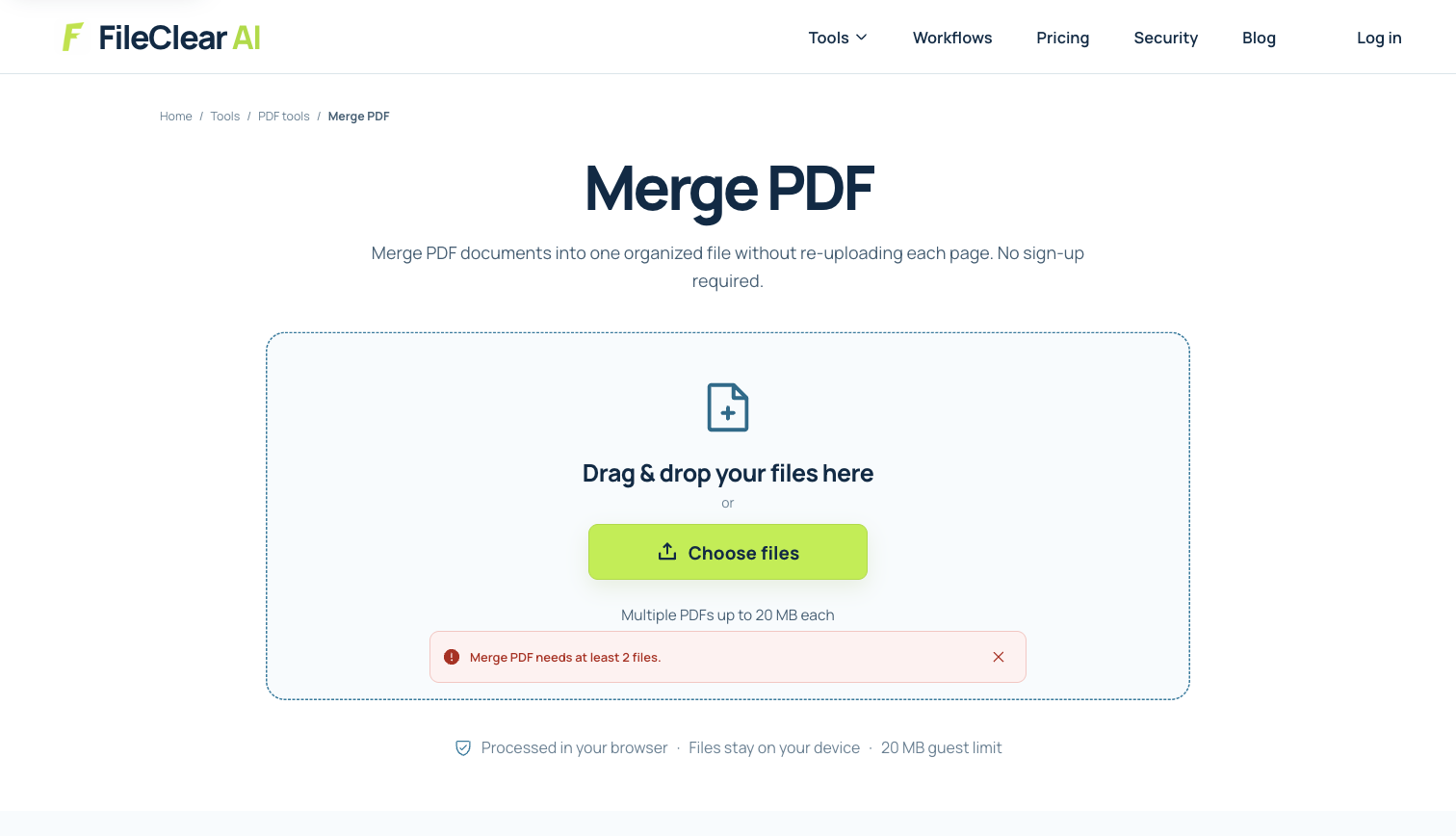
Reorder, rotate, split, merge, or remove PDF pages with a review process that protects page order, orientation, and the content you still need.
Define the finished document before changing pages
PDF organization is easier when the intended result is clear before any page is moved. Decide whether the output should be one complete document, several smaller files, or a selected set of pages for a specific recipient. Write down the expected page order, final page count, orientation, and file name. If the PDF contains sections, identify their starts and endings before editing. A short plan prevents common mistakes such as separating a heading from its content, placing an appendix before the section that references it, or deleting a blank page that was intentionally used for two-sided printing.
Work from a copy and keep the original unchanged. PDFs can contain bookmarks, links, forms, comments, signatures, attachments, layers, or page labels that are not obvious from thumbnails. Moving pages may change how those features behave even when every visible page still looks correct. Record the original file size and page count, then open several pages at normal size and at a closer zoom. If the document is signed or used as an official record, confirm whether reordering is permitted. A visually correct rearrangement can invalidate a digital signature or create a new document that needs separate approval.
Use thumbnails without trusting them alone
Thumbnail view is the fastest way to understand page sequence. Look for title pages, section headings, page numbers, recurring headers, color changes, and obvious orientation problems. Increase thumbnail size when two pages look nearly identical. Scanned forms, invoices, and contracts often repeat the same visual template, so compare dates, names, totals, or section labels before moving them. If the PDF mixes portrait and landscape pages, rotation may make the thumbnail easier to read without changing the intended place in the sequence. Treat rotation and ordering as separate decisions so one correction does not hide another mistake.
Visible page numbers are useful evidence, but they are not always reliable. A PDF can begin with an unnumbered cover, use Roman numerals for introductory pages, restart numbering in an appendix, or contain printed numbers that no longer match the file order. Some documents also use internal PDF page labels that differ from the number printed on the page. Build the sequence from document meaning first, then use printed numbers as a check. After rearranging, inspect every transition between sections instead of reviewing only the first and last pages. Most ordering errors occur where two groups of similar pages meet.
Choose merge, split, extract, or delete intentionally
Merging combines complete files or selected pages into one PDF. Put source files in the desired order before processing and check whether each file includes its own cover, blank separator, or duplicate attachment. Splitting creates smaller documents based on page ranges or individual pages. Name each result for its purpose rather than leaving recipients to interpret generic part numbers. Extracting keeps selected pages while preserving the original source, which is safer when only a subset should be shared. Deleting removes pages from the new output and should be reserved for content that is truly unnecessary, duplicated, or unauthorized for the final recipient.
Privacy decisions require more than deleting a visible page. Information can remain in bookmarks, annotations, form fields, attachments, metadata, or other pages that reference the removed content. Cropping is also not secure deletion because hidden material may remain outside the visible page box. When sensitive information must be removed, use a redaction workflow designed to eliminate the underlying content and review the exported result. When pages are removed for length rather than privacy, confirm that the remaining document still includes definitions, footnotes, legends, and explanatory pages needed to interpret tables or conclusions correctly.
Review order, orientation, and document features
Open the organized PDF in a second viewer and check the total page count against the plan. Scroll from beginning to end without skipping large ranges. Confirm every section start, the page before and after each moved group, every rotated page, and the final page. Search for a phrase from an early section and another from the appendix to verify that text is still available. Click important links and bookmarks, test form fields when they matter, and review comments or attachments that should remain. If a page was copied from another PDF, compare its size and margins with neighboring pages so printing does not produce an unexpected scale change.
For scanned documents, zoom in on fine text, stamps, signatures, and handwritten notes. Reordering pages should not require rasterizing them, but some workflows may rebuild the PDF or flatten interactive content. Compare a representative page with the original to make sure image quality and text selection were not changed unnecessarily. If OCR text is present, search and copy a sentence from several moved pages. Check landscape pages in both screen and print preview. A correct rotation should make reading easier without cropping the page or turning surrounding portrait pages in the wrong direction.
Create a repeatable organization workflow
For recurring documents, keep a simple checklist that names the accepted source, output structure, page ranges, naming rules, and review points. Standard packets such as onboarding forms, reports, applications, or monthly statements benefit from a stable section order. When inputs vary, mark required sections and optional sections separately instead of assuming the same page numbers every time. Use descriptive output names and include a version or date when several revisions may circulate. Store the approved source separately from a sharing copy, especially when the final document has removed pages or a different sequence from the record version.
A reliable PDF organization process is not measured only by whether the pages can be dragged into place. It protects document meaning, recipient scope, privacy, and the features people still need after the edit. Plan the result, work from a copy, choose the correct operation, inspect section boundaries, and verify the complete output in another viewer. If the document will support a legal, financial, medical, safety, or compliance decision, have an authorized reviewer confirm the final version. The goal is a PDF whose order is obvious, whose content is complete for its purpose, and whose changes can be explained later.
Continue this file task
Related guides
Frequently asked questions
- Does reordering PDF pages change printed page numbers?
- It changes file order but does not automatically rewrite numbers printed on each page or internal page labels. Review both after export.
- Is deleting a PDF page the same as redacting information?
- No. Deleting a page removes that page from the new copy, while references, metadata, attachments, annotations, or sensitive content elsewhere may remain.
- Can page organization invalidate a digital signature?
- Yes. Rebuilding or changing a signed PDF can invalidate its cryptographic signature even when the visible signature image remains.
Sources and further reading
- Organize PDF pages — Adobe Acrobat Help
- Move or copy pages within PDFs — Adobe Acrobat Help
- Extract pages from PDFs — Adobe Acrobat Help